
Corporate Governance In Nigeria: Law & Practice
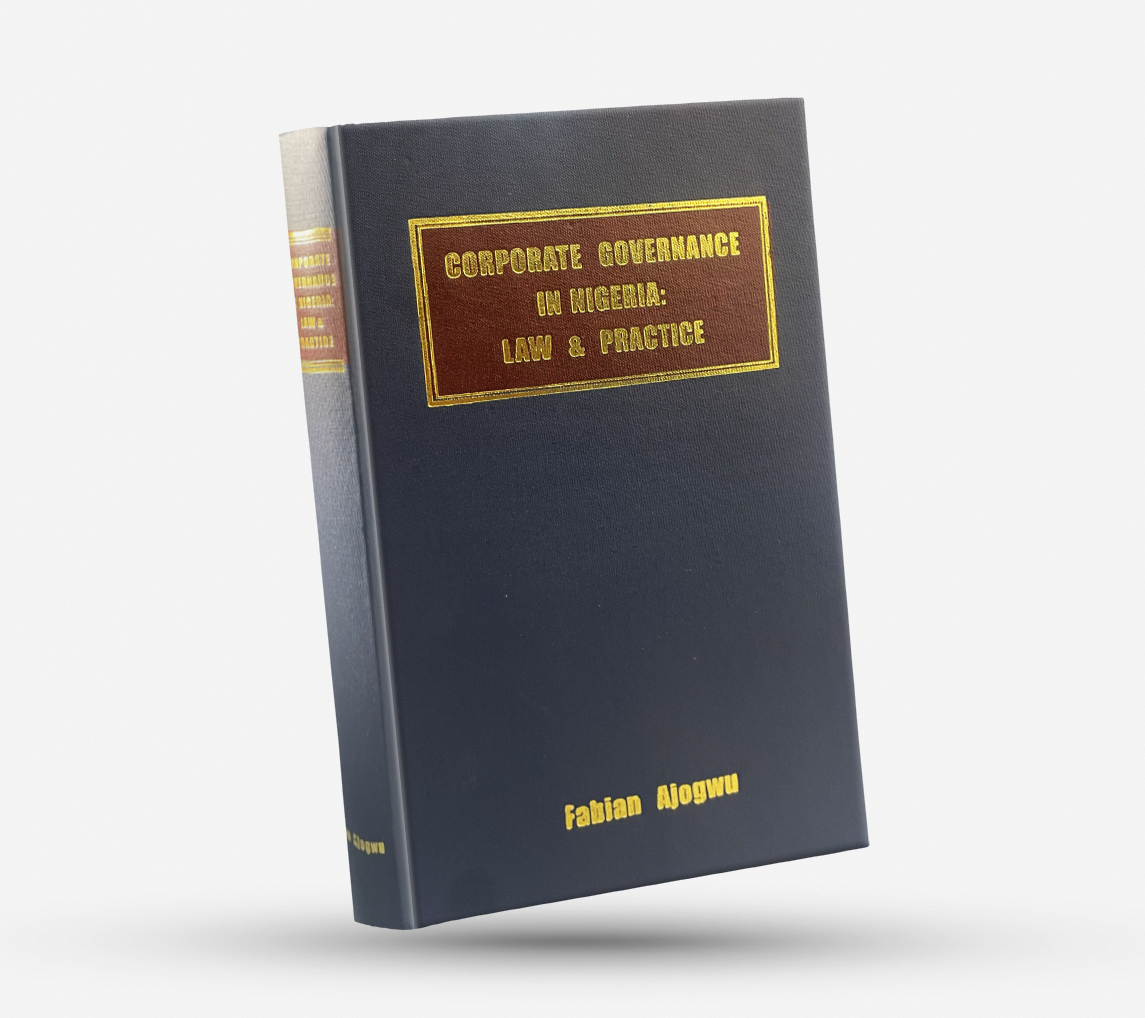
- ISBN: 978-978-084-464-6
It is a pleasure to be asked to contribute a preface to this magisterial work. Its importance and usefulness lie in the way in which Fabian Ajogwu has selected his material and conducted his research, to present a comprehensive piece on the Law and Practice of corporate governance in Nigeria. He has done this by laying out the fundamentals of corporate governance, carrying out a well-reasoned comparative analysis and study of corporate governance practices in Nigeria. More than anything, his excellent Introduction explains the origins of corporate governance and different governance models. There was no attempt on the part of the author to compare apples and oranges. This book compares Nigeria with other emerging markets of relatively similar size and stages of economic development. It looks at best practices in those jurisdictions and proffers guidance on best practices and code implementation from the perspectives of the stakeholders of an enterprise.
The Introduction lays out the principles of corporate governance, and illustrates the difficulty of arriving at any general concept of corporate governance across jurisdictions, given the inherent complexity of the subject, arising from the combination of economic and social roles by companies. The author presents the best practices in Nigeria, followed by an annotation of the Nigerian Code of Corporate Governance issued by the Securities and Exchange Commission. There is an attempt to critically evaluate the legal and ethical perspectives of the prescriptions of the code alongside issues of implementation and enforcement. In the Nigerian market, Governance structures are very important, in the sense that they have to be clear and understood to be effective, but their precise forms are less well understood. What really matters is the way in which companies, directors, officers and auditors put these structures to work, so that the enterprise is governed in a proper way.
The socio-economic and political environment of business, legal framework of business, and access to long-term finance, all together shape the forms of corporate governance within a jurisdiction. This book is a study of systems and processes in a continuous state of dynamism, and the practice of corporate governance has developed dramatically in the last decade, with a rapid need for it in Nigeria heightened in the wake of mergers and acquisitions, and intense capital market activities that characterised the years 2004 – 2007.
The rules have been laid down by the Securities and Exchange Commission by the introduction in 2002 of a Code of Corporate Governance, and more recently by the Central Bank of Nigeria in its own code for the banking and other financial institutions sector. These codes were written following consultations with industry stakeholders and practitioners. The author participated actively in drafting the first Code of Corporate Governance in Nigeria, and brings the in-depth knowledge of the key issues, the debates, the feed back from stakeholders and the regulatory authorities’ perspectives in his work on the law and practice of corporate governance in Nigeria.
There is no shortage of codes across jurisdictions, and we certainly do not need a separate code for each sector of the economy. It is hoped that the principles of corporate governance will catch up with practical experience and illuminate it. This may be a high expectation, but this book provides information on the relevant works on corporate governance, against which to compare, analyse, and assess the foundations on which so much has been built so rapidly. In addition to changes in structure and process, the balance of power between the lead players in the corporate field has shifted in the last half-century. Sir Adrian Cadbury puts it succinctly when he said –
“At the start, boards of directors were generally weak, executive management was in charge and shareholders were dispersed. Gathering investor pressure on the directors of under-performing companies, however, led to a strengthening of boards at the expense of management. This in turn developed into the present position whereby the concentration of shares in the hands of institutional investors has increased their power in relation to boards and management and, at the same time, drawn attention to their responsibilities in matters of governance”.
These changes occurred in jurisdictions where the capital market served as the primary source of raising capital. In jurisdictions where the banks are the primary source of raising capital, the balance of power is also shifting there. The focus in Nigeria is now on the governance of banks themselves and in turn, on their responsibilities for the governance of the companies, which they lend to. The forces driving these changes have been mainly regulatory as well as market-based, a point which is relevant to the issue of convergence internationally.
Following the completion of the consolidation exercise in the banking sector, the Central Bank of Nigeria handed down to bankers a code of corporate governance that was strengthened to meet the specific challenges facing the industry at the time. This leads on, however, to another question of balance, this time the balance between market forces and forces of regulation. Sarbanes-Oxley Act is a clear illustration of a regulatory reaction to a serious problem – the Enron collapse. Regulatory reactions often depend on the severity and scale of the need.
Codes of Corporate Governance are intended to regulate the conduct of directors, accountability to shareholders, recognition of the interest of other stakeholders and the need to encourage investment to flow where it could be most productive by raising in this case, the Nigerian corporate governance standards to the best international practices in comparable jurisdictions. This would appear to be the reason and purpose of corporate governance.
At whatever level the law and practice of corporate governance in Nigeria is studied and reviewed, there can be no doubt about the value of Mr Ajogwu’s book in clarifying the principles of corporate governance, the codes of corporate governance, and the supporting law and practice in Nigeria. For students of the subject, it is a one-stop shop, which sets corporate governance squarely in its practical context. For practitioners, executives, board members and policy-makers, it should be compulsory reading.
With the benefit of being at the forefront of commercial law practice in Nigeria in a full-service firm, the author brings to bear on the subject originality of thought and clarity of language, in a manner that makes for easy reading by boards, shareholders, institutional investors, managers, investment bankers, and lawyers old and young.
Emmanuel Ibe Kachikwu
LL.M (Harvard) Ph.D (Harvard), FCIArb,
Executive Director and General Counsel
ExxonMobile Nigeria
Lagos, September 1, 2007
The Board of Directors, being the think-tank of a company, have the primary responsibility of steering the activities of the company in a manner that will yield good results and eventual success for the company. This is done majorly through the efficient use of the company’s resources. Corporate Governance, the way and manner in which a company is run, inevitably determines whether a company will successfully achieve its objectives or not.
The first edition of this book, published in 2007 and comprising fifteen chapters, critically examined corporate governance principles whilst bringing to bear incidental issues to the topic. The challenge of agreeing on a general concept of corporate governance across jurisdictions was highlighted. It also featured the annotation of the Code of Corporate Governance issued by the Securities and Exchange Commission, Nigeria.
In this second edition, I have taken into cognisance key changes and developments in the Corporate Governance sector in Nigeria. The most important change being the release of the new Code of Corporate Governance principles (the Nigerian Code of Corporate Governance (NCCG), 2018) by the Financial Reporting Council of Nigeria (FRCN). Having been involved in the drafting of the Code, I have included annotations for the NCCG, identifying key issues that arise from the Code.
While tracing the historical timeline of the Corporate Governance Codes in Nigeria, I have compared some the sector-specific codes on Corporate Governance with the Nigerian Code of Corporate Governance, 2018. I also compared the 2011 Code of Corporate Governance for Public Companies with the Nigerian Code of Corporate Governance, 2018. Other new chapters have been introduced into the book, which includes: “Governance Structures, Systems and Economic Development, Corporate Governance and Risk Management, and How Independent Are Independent Directors”.
The revised edition of Corporate Governance in Nigeria: Law and Practice is generally a one-stop reference material on Corporate Governance in Nigeria. It promises to be of immense value to legal practitioners, students, stakeholders and any other person with an interest in Corporate Governance.
Professor Fabian Ajogwu, SAN
Lagos Business School
November 30, 2020