
Decoupling Ownership from Management of Companies
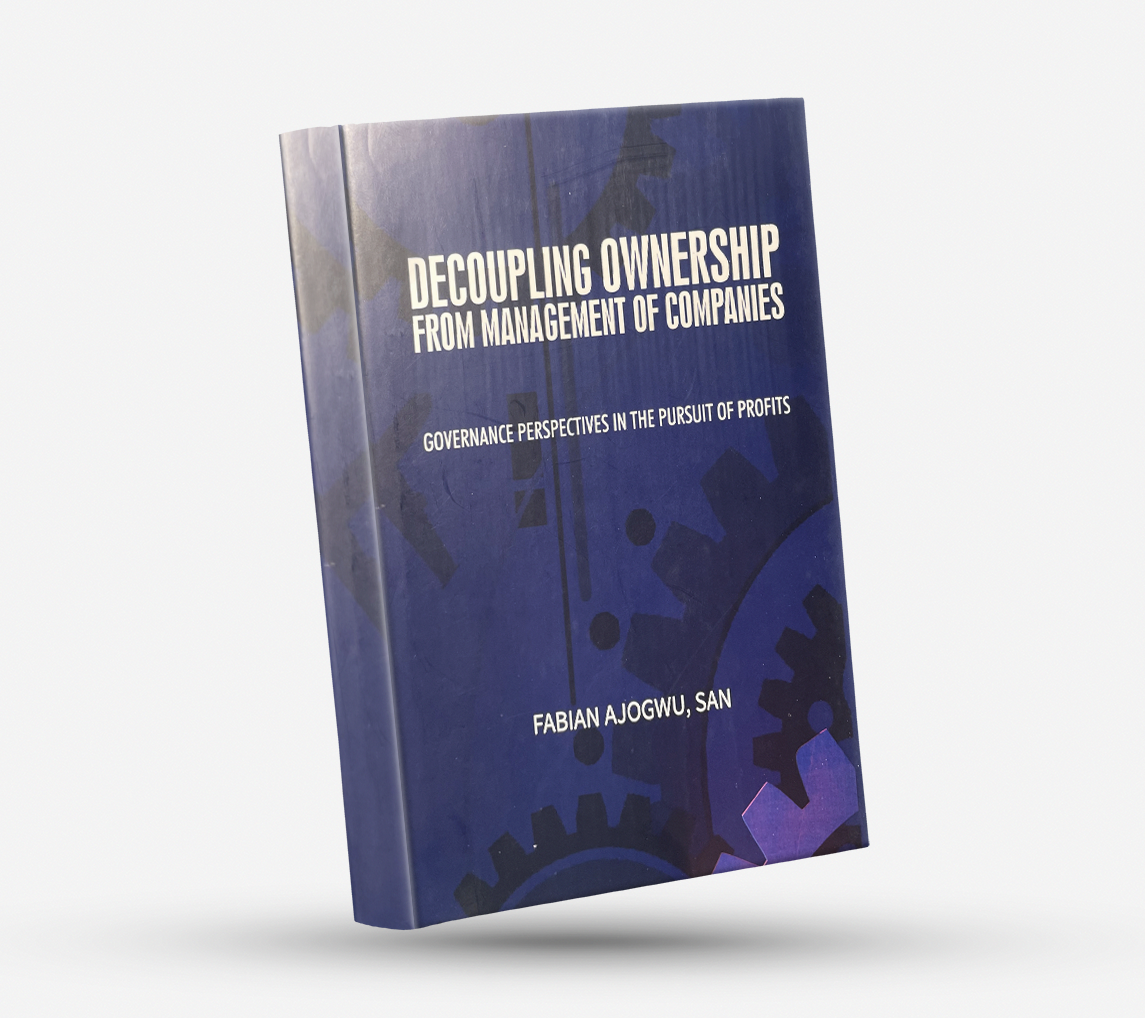
- ISBN: 978-978-950-689-7
My research and publications over the past two decades have somewhat concentrated on corporate governance, mergers and acquisitions, and commercial dispute resolution. It was therefore not an easy task to settle on a topic that would do justice of covering the field of study, as we say in the legal profession, and also contribute to learning and practice. The choice of a discussion on the theme of company law and corporate governance, stakeholder responsibility and the pursuit of profits, has been made to highlight what in my experience and findings, have essentially left the modern corporation at a crossroads – the tussle between owners and managers in the pursuit of profits.
The subject has been a constant for the past 20 years, with painstaking work of different aspects of corporate governance. My research initially focused on how to make boards more effective, and the emphasis was on the issue of independence of boards and accountability to stakeholders. Understandably, we were coming from a background of failed financial institutions in Nigeria. With reactionary market and regulatory responses to the challenges of corporate governance between the years 2001 and 2005, my works looked at the interplay between control and dispositions of the so-called agents of the principals. The works covered practical ways of enhancing the effectiveness of corporate boards through committees. My publications in this area covered the role of the chairman of the board, as well as the role of the company secretary as a custodian of corporate governance. The imperative of ethics as a pillar of corporate governance was the subject of several lectures, Workshops and papers between 2009 and 2010.
I was interested in the corporate structures of the key players in the telecommunications industry. One of the unique features of this industry was that the players had very high market capitalisation, but were private companies with core or dominant shareholders, id est, they each had a majority shareholder that drove the management of the company – MTN, Airtel, Etisalat, Glo, and Visafone. Being private companies, they were not regulated or guided by any of the existing codes of corporate governance before 2014. I took an interest in this area and gave a paper on the need for behavioural governance (beyond technical regulation only) in this very important industry.
The conclusions and reflections from the research aided discussions at conferences and workshops organised by the Nigerian Communications Commission in conjunction with the Society for Corporate Governance Nigeria to examine, among other things, the existing and desired practices of governance in the telecommunications sector. My effectiveness in the Nigerian telecommunications sector, as well as corporate governance against the background of debt and equity, provided insights into the appropriate direction for the regulation of that industry.
Part of my research between 2012 and 2013 looked at public institutions, especially state-owned enterprises and the governance of those institutions. In discussing with a group of Senators and House committee members, the inextricable link between public governance, public service, ethics and institutional reforms, a modest contribution was made towards dealing with the issue of public finance management and accountability in the public sector in Nigeria. In recent times, the discussion has been on several matters arising from corporate governance and the Financial Reporting Council of Nigeria Act 2011, as well as perspectives on the proposed National Code of Corporate Governance.
To get better insights into the evolving practices of corporate governance, I have in conjunction with others and under the auspices of the Society for Corporate Governance Nigeria, published the ‘Nigerian Observatory on Corporate Governance – Disclosure in Annual Reports for Public Quoted Companies in Nigeria’ yearly from 2010 to 2014 inclusive.
Insights from this Observatory publication led to further research work and publications in 2014 of the first comprehensive findings on corporate governance reporting in Nigeria of the top twenty most capitalised companies on the Nigerian Stock Exchange.
In sharing my thoughts on ‘Corporate Governance and Company Law: Decoupling Ownership from Management in the Pursuit of Profits’ in November 2015, the intention was to highlight the delineation of ownership rights, duties, privileges and powers from those of the management of the companies. ‘Decoupling’ as a transitive verb in this context means to separate, sever, disjoin, break up, disengage, or dissociate ownership from management of a company.
For clarity, the use of language must be precise – what is owned is not the company, but the shares (equity) in the capital of the company. It is intended to highlight the challenges that managers and boards face in having to seek continuously to balance the socio-economic rights and benefits of a range of persons, who have a success or failure stake in the company they run (beyond the obvious stakeholders – the shareholders). It is proposed to recommend how to properly balance these competing rights in the pursuit of profits in a capitalist and free economy.
Fabian Ajogwu, Ph.D., SAN, FCIArb
Professor of Corporate Governance
Lagos Business School
Pan-Atlantic, University
20th November 2015
The term ‘ownership’ has been the subject of much discussion with various definitions emerging over time. Ownership has been defined as the absolute right to alienate a property, the right to enjoy quiet and uninterrupted possession of it, and as I have more adversely expressed, the right to destroy it. I have held the view elsewhere that ownership is one of the highest forms of rights about a particular thing, provided that it is understood. It is my humble postulation that, that right is uniquely (but not exhaustively) distinguished by the ‘right to destroy’. You do not legally own that which you cannot lawfully destroy. That you cannot lawfully destroy, for instance, currency in your possession or your international passport, illustrates the point that you are not the owner in stricto sensu, but merely the ‘holder’. In other words, the litmus test of ownership is whether there exists a right to destroy lawfully, without more.
As illustrated in my book, Law & Society, “Mr. A can take off his jacket and burnt it, and no matter how wasteful we may think of him or unappreciative we may be of his actions, there is nothing anyone can do about it. However, the moment Mr. A asks other persons to contribute to the dry cleaning or re-fitting or improvement of the jacket in any form, he loses the right to destroy, at least without first consulting the persons who have so contributed.
This duty to account to all co-owners is what happens in a joint stock company or when one holds the Commonwealth in trust for others. It is even more, when Mr. A issues a private placement or a public offering, asking people to contribute to the improvement of an asset that was initially his, exclusively. Then the duty to account to the growing list of stakeholders increases. This duty increases as we hold the asset in trust for others.
These facets of true ownership are reflected in the Latin maxim, nemo dat quod non habet, which simply means that ‘no one can give what he does not have’, and in this context, that one cannot pass a title to a property that is not his to give. I have further extended that truism to include that no one can lawfully destroy what he does not have, just as no one can lawfully give what he does not have.
It is pertinent to state as I had done in previous publications, that although a company has been held and stated to be an artificial entity, with all the rights and powers of a natural person of full capacity conferred on it by law, it was however not the intention of Lord McNaughten in laying out this principle in the locus classicus of corporate personality in company law – the old English case of Salomon v Salomon Ltd, that there should be a total extrication of the importance of human behaviour in the management of these legal entities created by law. It was also not the intention of the various Companies Act and other corporation-specific statutes that codified the principle of artificial personality to eliminate the importance of human behaviour and accountability in the management of registered companies. It is the socio-economic nexus between managerial behaviour and company administration (or maladministration) that has brought about the subject – Corporate Governance. In simple words – Governance of the Corporation!
My preoccupation with corporate governance over the past 15 years culminated in assisting the Securities and Exchange Commission with drafting Nigeria’s pioneer Code of Corporate Governance for Public quoted companies in 2003, after about two years of interviews, debates, workshops, etc. it was to signal to investors and all other stakeholders that Nigeria was serious about adopting the global best practices of corporate governance. Some of the other results include founding a non-profit organization dedicated solely to promoting corporate governance through research, publication and advocacy among others. My research on the subject has also resulted in the publication of articles and some practice texts – Corporate Governance in Nigeria: Law & Practice (2007) and Corporate Governance and Group Dynamics (2013).
In my published works on corporate governance practices, I brought out some of the early day issues Nigerian companies faced as a result of attempts by significant shareholders to control the management and affairs of companies they are involved with. I tried to bring out the challenges of agreeing on a general concept of corporate governance across jurisdictions as a result of the different socio-political and economic environment prevalent in those jurisdictions at the time. In annotating the SEC Code of Corporate Governance among others in published works, I had presented the corporate governance practices in Nigeria and also highlighted the position of the law and attitude of the courts to matters of fiduciary duties, professional and board responsibilities and liabilities.
It has also been useful chairing the Nigerian Communications Commission Working Group that produced the 2014 Code of Corporate Governance for the telecommunications industry. The code of acceptance illustrates the power of stakeholder engagement in the quest for a more efficient and well-governed industry, and the same principle can be applied to a better and well-governed society. Membership of the NCC Committee was drawn from the telecommunications operators, who proffered suggestions that formed the basis and substance of the code.
Membership of the Working group includes MTN Nigeria, Airtel, Etisalat, HIS, Vodacom, NCC Senior Executives and a few Corporate Governance Experts.
My personal preoccupation with corporate governance can be pinpointed to some events within the past 22 years, which aim broadly at aligning stakeholder and management interests responsibly and fairly. These events include, but are not limited to, the corporate failures that adversely affected shareholders, employees, creditors, society, and governments in those jurisdictions. The corporate failures of the early 1990s set the stage to embark proactively on regulations and code that would guide the behaviour of managers to forestall the collapse being witnessed. I must acknowledge with deep gratitude the referral role of the Vice-Chancellor, Professor Juan Elegido in the early advisory work with the Securities and Exchange Commission on the subject in Nigeria at the turn of the millennium.
It is trite that no company can be too big actually to fail if its managers do not observe the practice of good corporate governance, Wilson captured this point when he cited the failures of Enron, Parmalat, World Com, and Barings Bank as illustrations of the point. According to Wilson, “a common thread that ran through these monumental corporate failures was the poor corporate governance culture, to wit, poor management, poor regulation and poor supervision”. The collapse of US giants, Enron Corporation and WorldCom, led to the legislation of the principles of corporate governance through the enactment of the Sarbanes-Oxley Act of 2002.
In Nigeria, the pioneering effort of the Securities and Exchange Commission in issuing a Code of Corporate Governance paved the way for other Regulators to issue industry-specific codes, such as the National Insurance Commission Code for the Insurance industry, the PenCom Code of Corporate Governance for the pension administrators, etc. The following codes emerged: – the SEC Code of Corporate Governance for Public Quoted Companies, 2011; PenCom Code of Corporate Governance, and the NCC Code of Corporate Governance, 2014.
A few principles emerged from the different events, and codes, namely a recognition of the rights and equitable treatment of shareholders 11, and a recognition of the interests of other stakeholders beyond shareholders (employees, creditors, customers, society, government, etc.) The principles also include the accountability of the board through a clear definition of the roles and responsibilities of the board; the integrity of financial statements, ethical behaviour and disclosure and transparency in the presentation of information relating to the company. My publications in this field have more recently been concerned with corporate governance practices where there are significant parent-subsidiary relationships. They sought to examine the difficulties associated with corporate governance in parent-subsidiary relationships and suggested ways through which corporate governance could be enhanced in the Nigerian banking and financial services sector.
I have also been preoccupied with the intricacies of mergers and acquisitions in Nigeria as vital tools used by companies to achieve long-term growth and increased revenue or profitability. Research in that area culminated in my publication of ‘Mergers and Acquisition in Nigeria: Law & Practice’, 2nd Edition, in the year 2014. The first edition, published in the year 2011, had been relied upon by the Court of Appeal in resolving the thorny issue of minority shareholder rights in the landmark case of Otunba Ojora v Agip Nig. It is considered a modest contribution to the development of legal jurisprudence on the subject of mergers and acquisitions, and protection of minority shareholder rights, to be relied upon by their Lordships, Augie JCA (as she then was), Nweze JCA (as he then was) and Iyizoba, JCA, to resolve landmark issues in company law and practice.
Fabian Ajogwu, Ph.D., SAN, FCIArb
Professor of Corporate Governance
Lagos Business School
Pan-Atlantic, University
20th November 2015